
Economy to grow 6.5% in 2016 on better macro conditions, says Mckinsey.

'The finance minister has done as much as she can when you look into the fiscal constraints she had.'

India's services sector remained in contraction territory for the third straight month in July, as business activity, new orders and employment declined further largely due to the COVID-19 pandemic and local restrictions, a monthly survey said on Wednesday. The seasonally adjusted India Services Business Activity Index rose from 41.2 in June to 45.4 in July, but was stuck in the red due to subdued demand conditions amid the COVID-19 crisis. In Purchasing Managers' Index (PMI) parlance, a print above 50 means expansion, while a score below 50 denotes contraction.

Capital expenditure by Indian companies is likely to see an uptick in the upcoming quarters as capacity utilisation has surpassed the critical threshold of 75 per cent, and numerous companies have deleveraged their balance sheets, according to analysts. The first quarter of the current financial year has shown improved profitability, driven by a decrease in input prices. This, according to analysts at Care Ratings, should stimulate a revival in the private capex cycle.

Fast-moving consumer goods (FMCG) sales continued to be lower in June compared to May with urban sales witnessing a steeper decline than rural. Sales of goods from shampoos to biscuits stayed lower due to inflationary pressures on commodities. This pushed consumer companies to continue taking price hikes, thus impacting demand, according to data by Bizom.

Leading FMCG companies reported a decline in margins in the September quarter on account of higher input costs and food inflation, which ultimately slowed down the pace of urban consumption. Rising prices of commodity inputs such as palm oil, coffee and cocoa were also accentuated and some FMCG firms have hinted at a price hike. HUL, Godrej Consumer Products Ltd (GCPL), Marico, ITC, and Tata Consumer Products Ltd (TCPL) have expressed concerns over squeezing urban consumption, which according to industry experts forms 65-68 per cent of FMCG total sales.

'The economy is clearly at a very soft spot, and earnings growth is disappointing every day.' 'After three great years, the Indian economy has hit a rough patch.'

Moody's Ratings on Tuesday said India's growing water shortage can disrupt farm and industry sectors and is detrimental to the credit health of the sovereign as rising food inflation and decline in income may spark social unrest. It said decreases in water supply can disrupt agricultural production and industrial operations, resulting in inflation in food prices and hence can be detrimental to credit health of sectors that heavily consume water, such as coal power generators and steel-makers.

The finance ministry has cautioned that global and regional uncertainties and domestic disruptions may keep inflationary pressures elevated in the coming months, warranting "greater vigilance" by the government and the Reserve Bank of India (RBI). "Russia's decision to terminate the Black Sea grain deal, along with dry conditions in major wheat-growing areas, caused a price spike in cereals. Domestic factors like white fly disease and an uneven distribution of monsoon exerted pressure on vegetable prices in India," the ministry said in its latest Monthly Economic Report for July, released on Tuesday. However, the report maintained, the recent price surge in certain food items "is expected to be transitory". "Tomato prices are likely to decline with the arrival of fresh stocks by the end of August or early September.

Prices may go up because of higher energy costs, caused by the rise in shipping charges, with commercial vessels taking a longer route to avoid the troubled Red Sea region, the finance ministry said on Monday. Iran-backed Houthi rebels of Yemen are repeatedly attacking ships in the Red Sea. While the global economy is grappling with challenges such as sticky inflation, sluggish growth, and mounting fiscal pressure, India's external sector could face "potential risks" due to the ongoing geopolitical tensions, according to the finance ministry's report on the review of the Indian economy.

A 6-7 million tonnes shortfall in rice production due to a fall in paddy sowing area is likely to keep rice prices at elevated levels, adding to the inflationary pressure that the slowing economy is already grappling with. Elevated food prices, including that of cereals, had led to retail inflation reversing a three-month declining trend, to touch 7 per cent in August. Similarly, the wholesale price inflation, which declined to 11-month low, also showed price pressures from cereals resulting from wheat output being impacted by severe heat waves in some parts of the country.
The Reserve Bank is likely to maintain status quo on interest rates in its forthcoming monetary policy review but may change the stance in view of retail inflation piercing its upper tolerance limit, global uncertainties created by the ongoing Russia-Ukraine war, and the urgency to protect and boost growth, feel experts. The RBI governor-headed rate setting panel -- Monetary Policy Committee (MPC) -- will be holding its first meeting of the 2022-23 fiscal from April 6 to 8. The outcome will be announced on April 8.

Global gold demand has seen a year-on-year decline of 8 per cent during the April-June period to 948.4 tonnes and going ahead further monetary tightening and continued dollar strength may pose headwinds, says a report. According to the WGC Gold Demand Trends Q2 2022 report, the total gold demand during the second quarter of 2021 stood at 1,031.8 tonnes. The year-on-year demand was affected by increase in gold electronic traded funds (ETFs) outflow, decline in Central banks buying and lower demand from the technology segment, the report said.

Foreign direct investment into the country is expected to rebound in the coming months on account of India's high economic growth, and steps to further improve the business environment of India, the Economic Survey said on Tuesday. The rise in global uncertainty in the wake of the Russia-Ukraine conflict, FDI equity inflows in the manufacturing sector in the first half of the current fiscal (April-September) fell below its corresponding level in the first half of 2021-22, the document, which was tabled in Parliament, said. The monetary tightening at the global level has further restricted the FDI equity inflows, the survey said.

HDFC was the top laggard in the Sensex pack, shedding over 3 per cent, followed by Infosys, L&T, Kotak Bank, Bajaj Finserv and Tech Mahindra.

Indian companies are planning to increase investments in the new year to expand capacity, acquire companies, and go on a hiring spree, a survey of top executives showed. They, however, cited rising costs, weak consumer demand, and increasing interest rates as major concerns for 2023 which may impact their plans.

Unseasonal rains watered down the performance of consumer durables companies as temperatures cooled, impacting the sales of refrigerators and air conditioners (ACs) in the 2023-24 (FY24) April-June quarter. Centrum says in its report on the sector that the trade channel indicates a 25-30 per cent year-on-year (YoY) decline in sales of refrigerators and ACs in April and May due to restricted buying. "While some green shoots in demand were visible in June, overall growth for the quarter is likely to remain at a negative 10-12 per cent," observes the brokerage.

SBI was the top loser in the Sensex pack, shedding around 3 per cent, followed by Bajaj Finserv, Tech Mahindra, Sun Pharma, Bajaj Finance and Axis Bank. Nifty fell 143.60 points to 17,873.60.

Equity markets would watch out for global cues in absence of any major event on the domestic front, and indices may face volatility in view of the scheduled derivatives expiry this week, analysts said. "During the week, volatility is likely to remain high due to the scheduled derivatives expiry of November month contracts on November 25. "At the same time, the focus would largely remain on the global markets for cues, in absence of any major event on the domestic front," said Ajit Mishra, VP Research, Religare Broking.

'Earning expectations remain strong.'

Benchmark BSE Sensex rose by over 379 points on Tuesday as gains in oil & gas, banking and auto shares helped the barometer continue winning run for the third straight session. The 30-share BSE benchmark index advanced 379.43 points or 0.64 per cent to settle at 59,842.21. During the day, it jumped 460.25 points or 0.77 per cent to 59,923.03. The broader NSE Nifty climbed 127.10 points or 0.72 per cent to 17,825.25 as 42 of its constituents advanced.

To balance growth and inflation, tax reforms such as GST and investments in increasing food productivity are vital

The slowdown in private consumption in the economy is taking a toll on the growth of fast-moving consumer goods (FMCG). The net sales growth of listed FMCG companies hit a 14-quarter low of 2.5 per cent in October-December 2023 (Q3FY24). This is the lowest revenue growth for the industry since the June 2020 quarter, when the FMCG firms in the Business Standard sample had reported a 13.2 per cent Y-o-Y decline in combined net sales owing to the lockdown.

Fitch's rival S&P had threatened to downgrade the rating to junk status, calling for immediate course-correction.

Reliance Industries was the top loser in the Sensex pack, shedding over 2 per cent, followed by SBI, UltraTech Cement, IndusInd Bank, NTPC and Sun Pharma. On the other hand, Maruti, M&M, Tech Mahindra, Bajaj Finance, Infosys and Bajaj Finserv were among the gainers.

The pay hike has been made effective from January 1, 2016.

Potato, a daily consumable vegetable, witnessed maximum inflationary pressure at 60.58 per cent

The Union Finance Minister Pranab Mukherjee on Thursday hoped that the steps taken by the government and those by the Reserve Bank of India would bring the inflation down to six percent by the end of this financial year.
The author of Riding the Indian Tiger says the inevitable end of U.S. dependence on oil will have far-reaching consequences for both consumer and producer nations

RBI had made available a potential liquidity of Rs 5.60 lakh crore (Rs 5.6 trillion), nearly 9 per cent of gross domestic product, to help the country tide over the liquidity crisis following the global financial meltdown triggered by the collapse of America's iconic investment banker Lehman Brothers in mid-September.
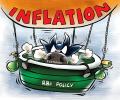
The RBI on Friday retained inflation forecast for FY23 at 6.7 per cent amid uncertain price trajectory on "geopolitical shocks" and on hope that inflationary pressures would ease with pick-up in kharif sowing and supply chain improvements. In its previous monetary policy review in June, it had projected retail inflation for 2022-23 at 6.7 per cent, higher from 5.7 per cent forecast in April. The six-member Monetary Policy Committee (MPC) unanimously decided to raise the benchmark repo rate by a steep 50 basis points to 5.40 per cent with immediate effect to tame inflation while supporting growth.

Gold, a safe-haven bet, is likely to continue its record-smashing journey in the New Year, rising to Rs 85,000 per 10 grams and even Rs 90,000 level in domestic markets if geopolitical tensions and global economic uncertainties continue.

Vegetable rates may ease from September, led by tomato prices, which have started showing signs of correction on the back of increased supply, Reserve Bank of India (RBI) Governor Shaktikanta Das said on Wednesday. "Looking ahead, the spike in vegetable prices in July is starting to see a correction, led by tomato prices. "New arrivals of tomatoes in mandis are already softening the prices, coupled with proactive supply management in the case of onions.

The report further noted that inflation is expected to fall to 4.5 per cent by quarter ended March 2017.

Multi-asset funds offer exposure to gold, which tends to do well in times of geopolitical tensions and inflationary pressures, suggests Sanjay Kumar Singh.
A repo rate hike may hurt growth far more than it will help deal with an inflation rate that is already dropping.

The Reserve Bank on Friday upped the cash reserve ratio from 5 per cent to 5.75 per cent, a move expected to flush-out Rs 36,000-crore (Rs 360-billion) from the system.
The Reserve Bank of India's (RBI's) caution on inflation, highlighted during the recent monetary policy meeting, may put investors' faith in fast moving consumer goods (FMCG) stocks to test, analysts said. They, however, believe FMCG stocks may ride through this near-term investor anxiety as related companies are, typically, well-equipped to handle inflation due to their pricing power and steady demand for essential goods.

This is the ninth consecutive month that the manufacturing PMI remained above the 50-point-mark.

Maruti Suzuki India will increase the prices of its vehicles 'substantially' from next month as it looks to offset the impact of rising input costs and make provisions to update the model range to conform to stricter emission norms which kick in from April 2023. In a regulatory filing on Friday, the country's largest carmaker said it continues to witness increased cost pressure driven by overall inflation and recent regulatory requirements. While the automaker makes maximum effort to reduce cost and partially offset the increase, it has become imperative to pass on some of the impact through a price increase, it added.
